"It is the responsibility of every political conservative, every evangelical Christian, every pro-life Catholic, every traditional Jew...to get serious about re-electing President Bush." - Jerry Falwell, The New York Times, July 16, 2004
"I think George Bush is going to win in a walk. I really believe I'm hearing from the Lord it's going to be like a blowout election in 2004. The Lord has just blessed him.... It doesn't make any difference what he does, good or bad." - Pat Robertson, AP/Fox News, January 2, 2004
These statements activated Sojourners to put a full-page in today's New York Times. Check out the ad.
Growing up in a home with a Republican dad and a Democrat mom convinced me that there is not just one way to view politics. Folks of good heart and mind can disagree on partisan politics. I am a healthy happy independent who has lived, worked, and worshipped among conservative Republicans for the last 30 years. Sojourners gives voice to many of my concerns.
Monday, August 30, 2004


Saturday, August 21, 2004
"Al tikrar biallem il hmar"*
My soul shudders when I see clips on CNN of the midrasas in the far reaches of Pakistan where young children absorb a combination of Islam with a virulent strain of anti-US hatred. The other day I was reflecting on this disturbing aspect of "that culture," when the images from the film with Robin Williams called Toys came to mind. Remember the Christmas-time flick from a few years back which portrayed an intentional military-toy industrial complex conspiracy to train Americans children to kill with video games and other toys? We recoil in horror at the training given to a portion of a generation of Arab-Muslim children, but how much pause do we give the training our young ones receive while playing video games? And to what extent does our media machine inculcate a strain of potentially virulent anti-Arab messages?
I started thinking about an article I once shared with my government classes. U.S. army officer and expert in the psychology of killing, David Grossman, made a case for banning certain video games from mainstream society because they were training kids to kill. The story ran as the Christianity Today cover, August 10, 1998, "Trained to Kill."
I mentioned this to a psychologist friend of mine who immediately poo-pooed this concern, but I hold to it. Just because, thankfully, he and his family don’t train their children to direct the killing skills of these video games to a certain ethnic or religious groups doesn’t mean that these games are not training American kids to be killers. I might add that for all of his family’s loving ways—there are millions who do articulate hatred for a variety of folks—especially those who appear to be among our country’s enemies.
Combine this concern with the one I heard raised last week in a recording of a book signing by Jack G. Shaheen, author of Reel Bad Arabs; How Hollywood Vilifies a People. In a study of 900 films, he tells of “the persistent and prolonged vilification of Arab peoples in mainstream Western movies.” (Okay, so I watch C-Span book reviews...) Shaheen expresses in a most articulate and passionate way his concern over the way slanderous stereotypes Americans have affected honest discourse and public policy." In his opening pages he quotes an *old Arab proverb, Al tikrar biallem il hmar-By repetition even the donkey learns. He decries a century of Hollywood "tutoring movie audiences by repeating over and over, in film after film, insidious images of Arab people."
I wonder--between Disney's Alladin and the evening news-- what images are being repeatedly given to our children of Arabs without any counterbalance? Could this be an unintentional parallel to the midrasas?
What prompted me to write was this weekend's New York Times Magazine story on "The Making of an X Box Warrior". Read it and speak. Is the American media machine from video games to the cinema not training our kids to kill and hate but in our own special way?
Consider this quote:
"Some military experts argue that while it is possible for the games to provide useful training for terrorists, the benefit of some of these games to the Army far outweighs any potential security hazard its theft might pose. ''This is going to give us a bigger edge than it gives to somebody else,'' said William Davis, who heads the lab that created the virtual weapons for the recruitment game America's Army. "
Saturday, August 14, 2004
Dowdy days of avocado and peach
Ken and Bev 70s 
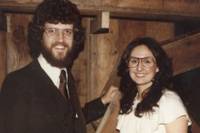
As the evening sun filtered through the 60s styled stained windows the soft colors dappled over the avocado green carpet and drapes. The mellow baritone voice of Ken Dowdy filled the air.
“You see, I’d like to share my life with you
Show you things I’ve seen
Places that I’m going to, places that I’ve been
To have you there beside, never be alone
And all the time that you’re with me
We would be at home”
(Song by John Denver)
“I’ll love you forever and forever
Love you with all my heart
Love you whenever we’re together
Love you when we’re apart…
Sing it loud so I can hear you
Make it easy to be near you
For the things you do endear you to me
Oh, you know I will, I will."
(Song by the Beatles)
The congregation sang.
For the beauty of the earth
For the beauty of the skies
For the love which from our birth
Over and around us lies
Lord of all to thee we raise
This our sacrifice of praise.
The girls in apricot and the guys in beige tuxedoes with apricot ruffled shirts stood up with us, sang to us, sang with us, and prayed with us. The parents, sans my Daddy who would have loved Ken Dowdy, blessed us. Our friends and family celebrated with food and fun for hours.
The fashion police and the music critics might cringe at a reprise of that wedding of 30 years ago, but there is nothing in this world I would trade for all the Dowdy days I have reveled in Ken’s love.


Thursday, July 29, 2004
Q's Questions
"Q" , a young woman, studies theology at Harding Graduate School of Religion. She blogs earnestly, asking heartfelt questions. She recently explored that ever sensitive territory of the Bible, God, and women. Sometimes, it is hard to describe how it feels to be a woman reading the Bible. There are moments that one wonders why God bothered to make women with minds and voices and then let them get educations. Q ventures some of these concerns on July 23 in a discussion about what she refers to as an invisible male bias in society. Here's my response:
There is more than one thing at work here. You identified what you consider invisible. My perception varies. What remains visible really is the power of the masculine. It screams at us from the images from Arab-Muslim nations and whispers to us in the contemporary church. As to the latter, lean in close and sense this simple representation of male privilege—presented with no malice, but because “it’s just the way things are” from James Wiser, a blogger you may appreciate. The blog brings to the table an announcement of a special day of encouragement designed for ministers and their wives sponsored by a Christian university.
Visible and disturbing in a visceral way is the crushing domination of women in many Arab Muslim communities. Veiled, silent, and subject even to point of socially sanctioned honor killings, these women live in a world I have to see as much like the world Jesus came into.
Now to the invisible. Imagine Jesus today in Saudi Arabia, Iraq, or Iran with an entourage of women talking theology. Think of Mary, with her spirit and mind as well the uniqueness of her female anatomic capacity, encountering Gabriel, trysting with the Holy Spirit, and experiencing the inner affirmation in her meeting with the expecting Elizabeth. Relish these encounters with the divine. Between us girls, the friendship of Jesus with Mary and Martha and the other women and baptism into Christ thrills me more than the circumcision deal the guys got before the new covenant. From my eye of faith, the appearance of Jesus to his followers, both male and female, and the partnership of Paul with women in the gospel supercede the problems, large as they loom, with roles in the burgeoning movement.
Cable televsion beams the ancient order of male authority so starkly that I am now thoroughly convinced of the fallacy of putting a literal contemporary application on some of Paul’s teachings. What is visible, Q, is this: we, women in the milieu of Churches of Christ, attend and work in groups of Christians who have utterly inconsistent, even schizophrenic applications of some scripture. This is not true for all folks who take God’s word for God’s word, but it is true for many. You live with this don’t you? As hard as it is in the meetinghouse, don’t miss the invisible reality of Christ and his vibrant, radical relationship with women for visibly weak attempts to appropriate the treasures of his will. And don’t quit asking questions, Q.
Wednesday, July 21, 2004
Spitting in the ocean
As genocide raged in Rwanda and the rest of the world "dithered" Carl Wilkens stayed and saved as many lives as he could. Today, Nicholas Kristof's column poses the question, "So, what would you do if, like Carl Wilkens, you were caught in the middle of genocide?"
Carl Wilken's story parallels the story of a Moravian missionary Samuel A. Worcester of Worcester v. Georgia fame. In the early 1800s this missionary took the cause of the Cherokees of Georgia all the way to U.S. Supreme Court. The court ruled in favor of the Cherokees, but Andrew Jackson, the hero of the common man in America, said that if Chief Justice John Marshall had an army, he can enforce his decision. The fate of the Cherokees fell to the Commander in Chief in the end, and the result was the tragic removal of the Cherokees to Indian Territory. But what did Worcester do? He walked the Trail of Tears with them and made his home in Indian Territory.
According to Kristof, Wilkens sent his family home, and all other missionaries left. "Of course, Mr. Wilkens managed to save only a tiny number of Tutsi in Kigali, and Americans sometimes ask if his work wasn't like spitting into the ocean. That's true, he acknowledged, adding, "But for the people you help, it's pretty significant."
So we know what what Worcester and Wilkins did. What would WWBevDo?
Sunday, July 11, 2004

Band Parents-"Kendred" spirits
Riffs, breakdowns, CDs $5.00 for 5 songs. Black hair, blue hair, $7.00 for 5 bands.
We are band parents, but not the regular kind.
Many East Cobb and North Fulton parents support their children's bands, but usually they are large marching bands with semi-trailer trucks carrying brass, wind, and percussion. These bands perform on football fields at half-time and in parades at Thanksgiving. Band parents I know spend countless hours raising funds--working concessions, organizing grapefruit sales, distributing chocolate bars. A myriad of projects advance their offsprings' musical passion. Marching bands command committment and achieve accolades.
We are band parents, but for an indie rock band. Indie rock kids perform in venues created from empty strip mall storefronts, community centers, church youth centers, and old factories converted into clubs. One time our son Trevor's band played on a trailer of a semi parked in the back of a church youth center. Indie rock band parents I know haul merchandise "merch" to shows--t-shirts, CDs, stickers, patches, and buttons. They bring lamps to set up in the back of dark rooms so kids can find a dollar for 2 buttons and patch with the bands name on it. Indie rock bands demand commitment and achieve accolades.
My son, Trevor Taylor Dowdy, played with Two Week Notice during his four years of high school. During that time, we went to every show that we could, experiencing a dimension of life we consider priceless. Frankly, indie rock kids can look anywhere from simply thrift store to--well, to the uninitiated band parent, downright frightening. For all of the ferocious dress, among the indie rock kids we persistently find gentle, intelligent, and thoughtful young artists. Many express profound faith in Christ and spend their lives serving Him.
Trevor, delights us with the love for Jesus he holds in his heart. He inspires us with his determination to create and innovate musically. He honors us by sharing the songs he writes day by day. Trevor warms our hearts with his love for his friends. Trevor pleases us with his perceptions about human nature and character. Trevor calms us with his careful driving and firm decision to avoid alcohol and other drugs. He encourages us by making us welcome with a hugs and introductions when we show up at his indie rock shows.
We treasure our time spent with Two Week Notice--Loryn Snell, Hudson and Abigal Philips, Andy Lee, and their kind and dedicated indie rock band parents. We miss seeing them at shows, maybe in somewhat the same way regular band parents miss the excitement of half-time shows and competitions. We remain grateful that Two Week Notice was not so independent that they wouldn't let us have a once in lifetime shot at being band parents.
Last night we went to hear Parksideview, a rocking indie band from Peachtree City that Trevor joined this spring. Ken and I renewed our acquaintance with Jen, a friend we met through Two Week Notice, and met a few new kids. We met Daniel Davidson of Norma Jean who touched us with his gentle spirit. While a young band waled out electronic experiments in the background we shared his enthusiasm for what he saw on his European tour and for old photos. Best of all, we observed his commitment to living and making music to honor Jesus. As parents, we felt a certain peace knowing our son meets guys like this in his indie rock world. So a little shout out to Daniel. Thanks for being open to us.
Tommorow Trevor and Parksideview--Jeff and Jake Turner, and Bobby Kyser pack up the merch box and go on tour sans parents. I am grateful for the Turners and Kysers and grateful for their kids. Quirky band parent facts: Two Week Notice dads were all ministers. Two of them are named Ken. Parksideview dads are all named Ken! Join us as we pray for their tour to bring glory to God, to provide great entertainment, and to be SAFE. We have to include the SAFE part, because We are PARENTS--the regular kind.
Wednesday, June 30, 2004
Kristof--a voice of reason
Nicholas Kristof speaks to me. I love to read his column in the NYTimes because he is pretty liberal, but he's--well--kind. I hope he doesn't mind that description, because it may sound very unjournalistic not to be described as bombastic, scathing, cynical, or strident. But in the national media, it's refreshing to read someone intelligent, analytical, but kind. He has spent a good bit of time this year writing on the sex trade in the Far East. While "on location" he ran into some International Justice Mission types, and seemed touched by their comittment. He said something nice about evangelicals.This shows he is not only kind, but courageous. Today he weighed in on the Micheal Moore phenomena. He broaches the Bush as liar rhetoric like this:
"A consensus is emerging on the left that Mr. Bush is fundamentally dishonest, perhaps even evil — a nut, yes, but mostly a liar and a schemer. That view is at the heart of Michael Moore's scathing new documentary, "Fahrenheit 9/11."
In the 1990's, nothing made conservatives look more petty and simple-minded than their demonization of Bill and Hillary Clinton, who were even accused of spending their spare time killing Vince Foster and others. Mr. Clinton, in other words, left the right wing addled. Now Mr. Bush is doing the same to the left. For example, Mr. Moore hints that the real reason Mr. Bush invaded Afghanistan was to give his cronies a chance to profit by building an oil pipeline there.
"I'm just raising what I think is a legitimate question," Mr. Moore told me, a touch defensively, adding, "I'm just posing a question."
Right. And right-wing nuts were "just posing a question" about whether Mr. Clinton was a serial killer.
I'm against the "liar" label for two reasons. First, it further polarizes the political cesspool, and this polarization is making America increasingly difficult to govern. Second, insults and rage impede understanding."
Kristof values understanding. Kristof, kind and courageous.
His writing raises hard questions, but I'm sorry, it just has a kind tone to it. Robert Coles (Pulitizer Prize winner who wrote the Moral Intelligence of Children) distills the meaning of morality as basic kindness. So hats off to a liberal with MORALS. Fancy that.
I dont' know how to do links yet, so here's the URL for Kristof today.
http://www.nytimes.com/2004/06/30/opinion/30KRIS.html?pagewanted=print&position=
Zach Blair's skin; Bev Blair's heart
Today Zac Blair, Bev and Bob's gorgeous 20-something ministerial student son, goes under the surgeon's knife. The doctors will excise two lymph nodes and some more skin to check for cancer cells. It seems to me that Zac ought to just be off at Camp Shiloh in upstate New York working with inner city kids in the name of Jesus. Seems that way to Zac, Bev, and Bob, too.
Five years ago on the Friday before Labor Day, Bev called me to say she was starting chemotherapy in the next morning for chronic myelogic leukemia. My husband Ken bought me an airline ticket, and I was there on Saturday morning when the nurse brought that first dose. Hundreds of people prayed for month after month for Bev's recovery from leukemia. After more than a year of frustration and unsatisfactory treatment options, she was able to be part of a "mercy trial" for Gleevec, a new drug that targets only the cancer cells. Last check, the oncologists can't find a red blood cell that tests positive for the disease.
So today, we hit the knee for Zac's skin and Bev and Bob's hearts. May God grant good health and inexplicable peace.
Bev, I wish that could be sitting in that waiting room with you.
Monday, June 28, 2004
Can we talk?
Over the utlimate suburban lunch at LaMadelines, she asked for help in reconciling her feelings about the discussions of politics at church. We attend a 90% white congregation in an affluent suburb of Atlanta. She is African-American married to a white man. She and the other black members at our congregation frequently feel offense at the presumption that all God-loving members of the flock vote Republican, love George Bush, resent (maybe even hate?) Bill Clinton, enjoy Rush Limbaugh and admire Sean Hannity. She expressed great concern about the morality of the abortion issue and gay rights, but feels that there are other issues with moral import---care for the sick, the poor, along with stewardship of the environment. So here's the discussion I would like to have. Are there some guidelines or suggestions we can make at our various congregations as this election approaches that will increase the unity of the spirit and the bond of peace, and minimize the divisiveness of politics? I believe it is safe to assume that the Republican party will be organized to mobilize voters even at the congregational level. What will the leaders of our congregations do?
Sunday, June 27, 2004
Walgreen Caribean blues
Blue eyes like the blue in the Caribbean Sea. She checks you out a Walgreens. Maybe you didn't notice her eyes because, like me, you are in a hurry. You grab the pack of gum, magazine, and bottle of lotion and head back to the car. But next time, when she checks you out, look at her for a second and tell her to have a good day. Maybe you could even strike up a short conversation if there isn't a long line. Say something about the weather in these parts and you will find out, she didn't grow up here. Maybe you could even sneak in a invitation to church. If nothing else, just a moment of warmth that conveys that you see her humanity and her worth. As you go out the door, say a prayer for her.
She might be my cousin. My beautiful cousin with Caribbean blue eyes. I saw her a few weeks ago, and asked what work she was doing. Her blue eyes turned bleary, her voice quivered and she replied with something like 'I'm just a cashier at Walgreen's. I'm just a dummy with a worthless job.' All the whys and hows that lead to that response hold a lifetime of hurts. When I think of the pain that little girl-grown woman's heart has held, it makes me a little short of breath. I feel something like physical pain in my chest. At the moment she said it, there were no words to fix it. There are no words now. But there is the Father. There is Jesus. There is the Holy Spirit. And there you are. Here I am. Maybe today when I see her, when you see her, we can ask on her behalf that she feel the love of the Father, the comfort of the Spirit, and redemption of the Son. We can look her in the eye, recognize her humanity and speak to her.
She might be my cousin. My beautiful cousin with Caribbean blue eyes. I saw her a few weeks ago, and asked what work she was doing. Her blue eyes turned bleary, her voice quivered and she replied with something like 'I'm just a cashier at Walgreen's. I'm just a dummy with a worthless job.' All the whys and hows that lead to that response hold a lifetime of hurts. When I think of the pain that little girl-grown woman's heart has held, it makes me a little short of breath. I feel something like physical pain in my chest. At the moment she said it, there were no words to fix it. There are no words now. But there is the Father. There is Jesus. There is the Holy Spirit. And there you are. Here I am. Maybe today when I see her, when you see her, we can ask on her behalf that she feel the love of the Father, the comfort of the Spirit, and redemption of the Son. We can look her in the eye, recognize her humanity and speak to her.
Friday, June 25, 2004
best friend
She's my best friend.
She's Beverly Birdwell Blair.
We were best friends when we were two years old. We were best friends before I remember being best friends. I cannot remember a time in my life when I did not know her.
I don't know how many Beverlys there are in the world, but in Warren, Michigan in the 1950s, I think maybe we were the only ones.
We met regularly in the basement of the ugliest church building in Warren, Michigan.Our families attended the Van Dyke Church of Christ on Nine Mile Road. Most of the other church buildings were Catholic or Lutheran, which were quite beautiful. The Van Dyke Baptist Church was really only prettier because they had a neon cross that beamed "Jesus Saves". The Van Dyke Church of Christ building with its red brick,flat roof, and beige linoleum with little brown streaks, sat next to the Sportman's Alibi Bar. We played tag on the lawn between the church and the bar, and the side of the bar was "goul." For those of you who did not grow up on the east side of Detroit, "goul" is the equivalent of "base" for hide and seek and tag.
Oh yes, we sat next to each other in bible class and in worship services in theater seats. Theater seats. I am not sure why we had theater seats,instead of pews, but I think it had something to do with being neither "Catholic, Protestant, nor Jew." Without fail, Beverly and Beverly were there every Sunday morning, Sunday night, and Wednesday night of our young lives, unless we were properly "providentially hindered."
Miss Maude Hall taught our pre-school Sunday School Class in, well, it was the ladies' bathroom. There we were, in the depths of the building, part of the Motor City, singing "This little Christian Light of Mine." The teacher was trying to teach us the song. We got through the "hide it under a bushel, NO!" verse, then the "don't let Satan pouf it" part and then came the last verse. Maude sang, "All around the neighborhood, I'm gonna let it shine." I remember Beverly Birdwell said, "No, no, no teacher! It's 'all around Gaineboro Road' I'm gonna let it shine." Gaineboro, was Beverly Birdwell's parent's hometown, way down in Jackson County Tennessee.
That architecturally challenged building housed a spiritual and cultural experience born from the poorest and richest of the South. Many of the South's poorest people came to work in those shops in and around Detroit, but for what our families lacked in money, they possessed an abundance of love.
Beverly and I grew up in and around and through that strange structure, that Van Dyke Church of Christ. Most of our visits to each other's homes began at the church building. We played house, pioneers, school, and church. In pretend church we preached and lead singing, but not in real church. We memorized our Bible verses and filled out our "Gospel Treasures" Sunday school lessons, on January 5, 1964, we were both baptized into Christ.
The two Beverlys dated the same boys, but never at the same time. We traveled from Detroit to Tennessee to Paris together. We traveled from the 50s to through the 60s together. We sat in those theater seats while the men of the church prayed for our security during the Cuban Missile Crisis. We rode together home from chorus practice in Detroit the night Martin Luther King was assassinated, sad and frightened. We watched the smoke rising from Detroit during riots and waved at the National Guard in full battle regalia patrol our neighborhoods. We traveled together from childhood to womanhood sharing secrets in the stairwells of the church building.
Incidentally, in 1966 our Dads and the other deacons worked together to provide a new Van Dyke Church building with pews and stained glass.
On a chilly Michigan fall in November of 1970, our senior year, Bev sat by my side while we heard that my Dad died from a heart attack. We began our grown up journey of faith. The next fall we were at separate universities and began our adult lives apart. Since then we have both married, born sons, and buried Beverly's dad.
That Van Dyke Church of Christ experience, with of its theological, cultural, and architectural eccentricities, besides introducing us to Jesus gave us the experience of being best friends IN JESUS. Beverly let her little shine all around Gainesboro Road when she visited her cousins in the summers, all around Centerline High when she excelled in all academics and student leadership, and all around Abilene Christian University and Central Michigan University. Now she shines all around the schools where she teaches special education, all around her home where loves and nurtures four of the world's best looking men, and all around my life where, though time and space keep us at a distance, she remains my best friend.
Now, I hope I have made up for leaving her name out of my blog on a cappella music.
Monday, June 21, 2004
"Patriotism is the certain death of Christianity"
If he had been born a few years earlier he would have been in Hitler's Youth. A young school-aged child, he and his single mother dodged Allied bombs in a besieged Berlin. She ended up in the brutal fray of the fallen capital, ravaged by Russian soldiers. Mother and son survived on potato peelings and hope, and finally escaped from a Russian detention camp. As the buildings cooled and survivors picked through the rubble of their lives and their city, the Allies arranged the joint occupation of Berlin. Determined missionaries from the Church of Christ, part of the Stone-Campbell restoration movement, led by a deeply loved preacher, Otis Gatewood, reached the young mother with a simple gospel message. Sometime after her baptism, she met and married an American G.I. The couple returned to the states, bringing the young man to complete his education in America.
Enthusiasm for history and social issues characterized this young man as he grew. I met him when he was an undergraduate at a Christian college. He married my next-door neighbor, and became a secondary social studies teacher. Two indelible impressions from him informed my political socialization and to a certain extent influenced my approach to Christian thought. First, he taught me the word "ethnocentrism" when I was ten years old, clearly showing its insidious nature. Secondly, he had a small sheet of paper posted above his desk that bore these words, "Patriotism is the certain death of Christianity."
To an American evangelical in these early days of the millennium, the first idea may not be a cause for alarm, but the latter may smack of something sinister. Post 9/11, even the baby boomers disillusioned by Vietnam found their way to Wal-Mart to buy an American flag. I know I cut an American flag out of the Atlanta Journal Constitution on 9/12, laminated it, and hung it on my classroom wall. It hangs there today. 9/11 and many other factors have lead to an increasingly close relationship between evangelical Christianity and patriotism. This tie, strenghthened by radio talk shows, websites, interest groups, and a secular news network confirming its leanings, alarms me. My experience today raised concern.
First, the AJC reported that the National Association of Evangelicals is "mulling over guidelines that would warn the faithful against allying themselves too closely with any one political party, 'lest nonbelievers think that the Christian faith is essentially political in nature." The mulling over process is a start.
Next, only a few pages over, the AJC ran a story headlined "Christian 'exodus’ to S.C. planned-Texan envisions state free of liberal meddling". Determined to stop the federal government from "imposing what he considers its liberal will, he wants South Carolina to secede." This fellow wants to get 12,000 Christians to move to South Carolina in order to take over the state government and enact a set of laws friendly to his political ideology, which he bases on his interpretation of scripture. It brought some relief to read that the conservative speaker of the State House in South Carolina and a spokesman from Bob Jones University both panned the idea. Nonetheless, 600 folks have signed up. According to the AJC, he's been given some positive press from conservative talk show personalities and websites.
Today I sat in a class of teachers preparing to teach Advanced Placement Comparative Politics and Government. I wish some of my precious Christian friends could hear the perceptions they have of Christians. These perceptions come directly from the stridency and partisanship of the current political climate. It hit me as ironic when the distinguished professor came to a brief discussion of "the functions of ideology". One such function, political scientists assert, is to give one the ability to get along---to be socially accepted. My understanding of the Word is that our spiritual kinship in Jesus makes us one of the bunch. However, the climate today among my believing friends is so partisan and nationalistic, that some look askance if you indicate that you question the current administration's policies. Some believers assume that their interpretation of politics is so right and righteous, that they bring to the assembly of Christians political statements, both serious ones and others they consider funny. For example, just this past Sunday, one of my dearest friends and a brother in Christ asked, in an organized Bible study setting, “So, who is going to buy Bill Clinton’s book this week?” His tone was intentionally pejorative.
My over “three score and ten” mother, a Roosevelt Democrat, replied, “I plan to buy the book; I love Bill Clinton.” The group fell completely silent, and the teacher dropped the topic. Oops. Political ideology did not function to make her part of the group.
What is a person possessing a different political persuasion to do? Counter partisan political remarks, therefore sounding argumentative, or sit silently in order to keep peace? Keeping silent on political remarks to keep the peace may have a biblical basis. This could be an equal opportunity silence. Presuming partisanship and demanding a form of patriotism is not the ideology Christ declared would bring us together.
The NAE indicates that it wants its members to avoid the excesses of nationalism, but encourages “maintaining a commitment to religious freedom at home and abroad and opposition to some specified social evils---alcohol, drugs, abortion, and stem-cell research.” Profound problems and debates surround the issues listed, but even the comments of this disclaimer make it no wonder "nonbelievers think that Christianity may be essentially political in nature."
What if the NAE said, "Let's avoid the excesses of nationalism and concentrate instead on making disciples, feeding the hungry, clothing the naked, and otherwise helping the poor--especially single mothers and fatherless children. Let's be known for healing the sick, welcoming immigrants to our community, and spending time with prostitutes, drug addicts, and other social misfits. Let's count it a joy if the state persecutes us for the sake of the faith and, by all means, let us be peacemakers." Some believers might look askance and even decide they better join the exodus to South Carolina.
Sadly,the nonbelieving public hears exponentially more about evangelical views on a political issues than they do about the many good works done, but this statement by the NAE confirms, it is not just the liberal media waylaying the message.Evangelicals and other conservative Christians need to own up to their part in obscuring the core of the gospel to nonbelievers, and by their presumption, creating wedges between members of the Christian community.
“Patriotism is the certain death of Christianity.” This statement is extremist, even outrageous to us, but the warning appeared on my neighbor's wall as a legacy of national spirit gone wrong. Certainly, thoughtful civic concern and action will not hammer a nail in the coffin of Christianity, but speaking and acting in such a way that the greater society mistakes the nature of the kingdom, seems worthy of at least a surgeon general's warning.
Subscribe to:
Posts (Atom)


